A peptide corresponding to the C-terminal
region of pleiotrophin inhibits angiogenesis in vivo and in vitro
Mikelis, C., Lamprou,
M., Koutsioumpa, M., Koutsioubas, A.G., Spyranti, Z., Zompra, A.A.,
Spiliopoulos, N., Vradis, A.A., Katsoris, P., Spyroulias, G.A., Cordopatis, P.,
Courty, J., Papadimitriou, E.
Journal of Cellular
Biochemistry 2011112,
Pleiotrophin (PTN)
is a heparin-binding growth factor that plays a significant role in tumor
growth and angiogenesis. We have previously shown that in order for PTN to
induce migration of endothelial cells, binding to both ανβ3 integrin and its
receptor protein tyrosine phosphatase beta/zeta (RPTPβ/ζ) is required. In the
present study we show that a synthetic peptide corresponding to the last 25
amino acids of the C-terminal region of PTN (PTN112–136) inhibited
angiogenesis in the in vivo chicken embryo chorioallantoic membrane (CAM) assay
and PTN-induced migration and tube formation of human endothelial cells in
vitro. PTN112–136 inhibited binding of PTN to ανβ3 integrin, and as shown
by surface plasmon resonance (SPR) measurements, specifically interacted with
the specificity loop of the extracellular domain of β3. Moreover, it abolished
PTN-induced FAK Y397 phosphorylation, similarly to the effect of a neutralizing
ανβ3-selective antibody. PTN112–136 did not affect binding of PTN to
RPTPβ/ζ in endothelial cells and induced β3 Y773 phosphorylation and ERK1/2
activation to a similar extent with PTN. This effect was inhibited by
down-regulation of RPTPβ/ζ by siRNA or by c-src inhibition, suggesting that
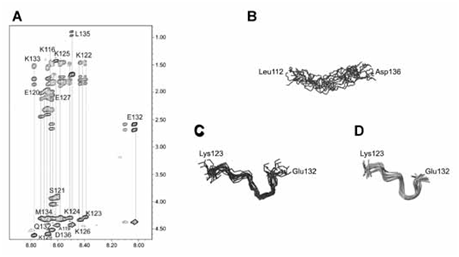
PTN112–136 may interact with RPTPβ/ζ. NMR spectroscopy studies showed that
PTN112–136 was characterized by conformational flexibility and absence of any
element of secondary structure at room temperature, although the biologically
active peptide segment 123–132 may adopt a defined structure at lower
temperature. Collectively, our data suggest that although PTN112–136 induces
some of the signaling pathways triggered by PTN, it inhibits PTN-induced
angiogenic activities through inhibition of PTN binding to ανβ3
integrin.
Read more